La majorité des montages tétraédriques proposés en Angleterre à la fin des années soixante présentaient des distorsions spatiales évidentes favorisant le quadrant avant. Seul le montage de Gerzon ne présentait aucune distorsion spatiale pour quelque direction que ce soit. Ce montage présentait cependant un inconvénient majeur : tel quel, il fallait alimenter un assemblage d’enceintes acoustiques peu flexible. Il a donc fallu repenser certains principes qui alourdissaient l’utilisation du modèle tétraédrique. La première étape pour un développement subséquent de ce modèle était de mettre de côté l’obligatoire analogie de position entre les capteurs à l’enregistrement et les émetteurs à la reproduction. Pour cela, il fallait trouver un format de signal intermédiaire qui allait permettre d’adapter une prise de son tétraédrique à n’importe quelle disposition d’enceintes acoustiques.Most of the tetrahedral arrays proposed in England in the late sixties showed obvious spatial distortions favouring the front quadrant. Only Gerzon’s array showed no spatial distortion in any direction. This array did, however, have a major drawback: as it stood, it had to feed a rather inflexible loudspeaker array. Certain principles that made the tetrahedral model cumbersome to use therefore had to be rethought. The first step towards further development of this model was to set aside the obligatory positional analogy between the capsules in recording and the emitters in reproduction. To do this, an intermediate signal format had to be found that would make it possible to adapt a tetrahedral recording to any loudspeaker arrangement.
Figure 5.1 Les quatre capsules du format-A de l’Ambisonie. [D’après Craven et Gerzon 23]Figure 5.1 The four capsules of the Ambisonic A-format. [After Craven and Gerzon 23]
Ce principe est le coeur de l’Ambisonie35. Ce système se schématise en quatre sections appelées « format-A, format-B, format-C et format-D »33. À partir des quatre signaux issus d’un montage tétraédrique régulier de microphones cardioïdes, appelé le format-A et illustré à la figure 5.1, il est possible d’obtenir, en additionnant et soustrayant ces signaux entre eux, quatre nouveaux signaux de microphones virtuels correspondant à trois harmoniques sphériques simples de premier ordre, orientées à 90° les unes par rapport aux autres, plus une harmonique sphérique d’ordre zéro. Ces micros ont tous le même centre de gravité et les signaux de premier ordre correspondent aux trois axes X, Y, et Z de la figure 1.1, définissant l’espace en trois dimensions. Illustré dans la figure 5.2, ce format intermédiaire, qui ne peut alimenter directement des enceintes acoustiques, s’appelle le format-B et serait en quelque sorte une extension tridimensionnelle d’une captation M-S. Les signaux de premier ordre du format-B sont assez justement désignés « X » pour celui qui pointe vers l’avant, « Y » pour celui qui pointe vers la gauche, « Z » pour celui qui pointe vers le haut et « W » pour l’omnidirectionnel31. La figure 5.1 nous montre qu’en attribuant aux capsules du tétraèdre d’origine les désignations C1, C2, C3 et C4, la conversion du format-A au format-B se fait selon les combinaisons suivantes :This principle is at the heart of Ambisonics35. The system can be schematized in four sections called “A-format, B-format, C-format and D-format”33. From the four signals produced by a regular tetrahedral array of cardioid microphones, called the A-format and illustrated in figure 5.1, it is possible, by adding and subtracting these signals, to obtain four new virtual microphone signals corresponding to three simple first-order spherical harmonics, oriented at 90° to one another, plus a zero-order spherical harmonic. These microphones all have the same centre of gravity, and the first-order signals correspond to the three axes X, Y and Z of figure 1.1, defining space in three dimensions. Illustrated in figure 5.2, this intermediate format, which cannot directly feed loudspeakers, is called the B-format and could be seen as a three-dimensional extension of an M-S capture. The first-order signals of the B-format are quite aptly designated “X” for the one pointing forward, “Y” for the one pointing to the left, “Z” for the one pointing upward and “W” for the omnidirectional31. Figure 5.1 shows that, by designating the capsules of the original tetrahedron C1, C2, C3 and C4, the conversion from A-format to B-format is made according to the following combinations:
(4) C1 + C2 + C3 + C4 = W (5) C1 + C2 - C3 - C4 = X (6) C1 - C2 + C3 - C4 = Y (7) C1 - C2 - C3 + C4 = Z
Par ailleurs, le format-B permet de créer n’importe quel microphone correspondant à une harmonique sphérique simple ou complexe de premier ordre et ce, pointant dans n’importe quelle direction. C’est aussi le format dans lequel toutes les manipulations prémixage de signal doivent intervenir.Moreover, the B-format makes it possible to create any microphone corresponding to a simple or complex first-order spherical harmonic, pointing in any direction. It is also the format in which all pre-mix signal manipulations must take place.
Figure 5.2 Représentation sphérique des quatre canaux du format-B de l’Ambisonie. [D’après Farrar 31]Figure 5.2 Spherical representation of the four channels of the Ambisonic B-format. [After Farrar 31]
Le format de signal choisi pour la transmission ou l’inscription sur un support donné destiné à la consommation est le format-C. Ce format peut être de quatre, trois ou deux canaux : le format-C à quatre canaux contient l’information tridimensionnelle complète, le format à trois canaux contient l’information bidimensionnelle horizontale complète, en enlevant le signal Z, sans perte de séparation entre les canaux, alors que le format-C à deux canaux contient l’information bidimensionnelle (X, Y et W) encodée, donc avec une certaine perte de séparation entre les canaux46. C’est une matrice 3:2:3 et la séparation entre les canaux est de 6 dB puisqu’ils sont tous spatialement adjacents78. Toutes les équations matricielles d’encodage ont été déterminées de façon définitive et ce mode d’encodage du format-C est employé commercialement sous l’appellation « Ambisonic UHJ »37. Le UHJ a emprunté son appellation, et une partie de ses équations, à d’autres systèmes de matriçage. La lettre U, qui vient du système UMX (commercialement UD-4) développé par Cooper et la compagnie Nippon Columbia99, signifie Universal. La lettre H, qui vient du système Matrix H ou HJ de la British Broadcasting Corporation (BBC), signifie Hierarchical. La lettre J vient du système 45J de la National Research Development Corporation (NRDC). La signification exacte du J n’est pas très claire, mais un document interne de la NRDC stipule que c’était le numéro du projet de laboratoire100. D’un autre côté, peut-être une pure coïncidence, la lettre J est employé comme constante dans toutes les équations de tous les systèmes matriciels pour désigner un déphasage de 90°.The signal format chosen for transmission or for recording on a given consumer medium is the C-format. This format can have four, three or two channels: the four-channel C-format contains the complete three-dimensional information, the three-channel format contains the complete horizontal two-dimensional information, by removing the Z signal, without loss of separation between channels, while the two-channel C-format contains the two-dimensional information (X, Y and W) encoded, and therefore with some loss of separation between channels46. It is a 3:2:3 matrix, and the separation between channels is 6 dB since they are all spatially adjacent78. All the matrix encoding equations have been definitively determined, and this C-format encoding mode is used commercially under the name “Ambisonic UHJ”37. UHJ borrowed its name, and some of its equations, from other matrixing systems. The letter U, which comes from the UMX system (commercially UD-4) developed by Cooper and the Nippon Columbia company99, stands for Universal. The letter H, which comes from the British Broadcasting Corporation’s (BBC) Matrix H or HJ system, stands for Hierarchical. The letter J comes from the 45J system of the National Research Development Corporation (NRDC). The exact meaning of the J is not very clear, but an internal NRDC document states that it was the number of the laboratory project100. On the other hand, perhaps by pure coincidence, the letter J is used as a constant in all the equations of all matrix systems to designate a 90° phase shift.
Le système UHJ, tout comme le format-B, comporte quatre signaux pour définir l’information tridimensionnelle complète. Toutefois, le format UHJ, contrairement au format-B, peut être directement écouté. Voyons comment cela est possible. Les quatre signaux UHJ ont les désignations suivantes : S, D, T et Q46. Le signal S est une combinaison des signaux W et X du format-B. Le signal D est une combinaison des signaux W, X et Y, mais avec des modifications de gain, de polarité et de phase. Le signal T est une combinaison différente des mêmes signaux de format-B que l’on retrouve dans le signal D. Le signal Q est essentiellement le signal Z du format-B. Pour l’encodage UHJ à deux canaux, les canaux S et D sont combinés sur le support (CD, cassette) d’une façon similaire à une matrice M-S : « S+D » donnant le canal gauche et « S-D » donnant le canal droit. Pour simplifier, on peut dire qu’en format UHJ deux canaux, les positions sur l’axe Y sont encodées par différences d’amplitude (comme dans toute prise de son stéréophonique coïncidente) et les positions sur l’axe X sont encodées par différences de phase35. Bien que le format UHJ se compose des signaux S, D, T et Q, il pourra être inscrit, sur les différents supports, Gauche, Droit, T et Q. La combinaison des canaux S et D sur les supports conventionnels assurera ainsi la compatibilité avec une écoute stéréophonique non décodée. Étant donné que le canal D est assimilable à une sommation monophonique d’un enregistrement stéréophonique conventionnel, il sera donc le signal écouté lors d’une réception radio MF mono. On peut imaginer des supports (disque numérique) ou des canaux de transmissions (radio MF) incluant les quatre canaux UHJ, mais dont les possibilités de lecture pourraient être d’un canal (S), de deux canaux (Gauche et Droit ou S et D), de trois canaux (S, D, T) ou de quatre canaux.The UHJ system, like the B-format, has four signals to define the complete three-dimensional information. However, the UHJ format, unlike the B-format, can be listened to directly. Let us see how this is possible. The four UHJ signals are designated as follows: S, D, T and Q46. The S signal is a combination of the W and X signals of the B-format. The D signal is a combination of the W, X and Y signals, but with modifications of gain, polarity and phase. The T signal is a different combination of the same B-format signals found in the D signal. The Q signal is essentially the Z signal of the B-format. For two-channel UHJ encoding, the S and D channels are combined on the medium (CD, cassette) in a way similar to an M-S matrix: “S+D” giving the left channel and “S-D” giving the right channel. To simplify, one can say that in two-channel UHJ format, positions on the Y axis are encoded by amplitude differences (as in any coincident stereophonic recording) and positions on the X axis are encoded by phase differences35. Although the UHJ format consists of the S, D, T and Q signals, it can be recorded on the various media as Left, Right, T and Q. Combining the S and D channels on conventional media thus ensures compatibility with undecoded stereophonic listening. Since the D channel is comparable to the mono sum of a conventional stereophonic recording, it will therefore be the signal heard in mono FM radio reception. One can imagine media (digital disc) or transmission channels (FM radio) including all four UHJ channels, but whose playback could be one channel (S), two channels (Left and Right, or S and D), three channels (S, D, T) or four channels.
Finalement, le signal combiné qui servira à alimenter l’installation d’enceintes acoustiques sera le format-D. Ce signal ne vient pas directement du format-C (format de transmission), mais plutôt du format-B (format de manipulation) reconstruit à partir du format-C. Rappelons-le, c’est le format-B qui permet la synthèse de microphones, donc de synthétiser des micros dont l’azimut, l’élévation et les caractéristiques directionnelles correspondent au nombre et à la disposition des enceintes acoustiques utilisées.Finally, the combined signal used to feed the loudspeaker installation will be the D-format. This signal does not come directly from the C-format (transmission format), but rather from the B-format (manipulation format) reconstructed from the C-format. Let us recall that it is the B-format that allows microphone synthesis, and therefore the synthesis of microphones whose azimuth, elevation and directional characteristics correspond to the number and arrangement of the loudspeakers used.
Comme nous pouvons le constater, autant pour le format-B que pour le format UHJ, l’emploi de ce qui est appelé un décodeur ambisonique est obligatoire. Présentement, il n’y a, pour autant que nos informations soient à jour, que trois compagnies, AGM Digital, Audio Design et Minim Electronics, manufacturant les décodeurs ambisoniques. Ces décodeurs permettent de décoder tant le format-C UHJ que le format-B de studio. Au début des années quatre-vingts par contre, plusieurs compagnies britanniques produisaient des décodeurs domestiques ou professionnels en plus d’autres appareils de traitement permettant la synthèse du format-B à partir de bandes multipistes. Nous en reparlerons plus loin dans la section 5.3. Trois compagnies japonaises, Hitachi, Mitsubishi et Onkyo, incorporent des décodeurs Ambisonic UHJ deux canaux dans leurs processeurs d’ambiances ou dans leurs récepteurs hauts-de-gamme aux côtés d’un décodeur Dolby Surround. Les consommateurs ne se trouvent donc pas dans la délicate position de choisir un système ambiophonique* au détriment d’un autre. Détail technique intéressant, les décodeurs incorporés dans les appareils de Mitsubishi et Onkyo fonctionnent complètement dans le champ d’activité numérique. On peut donc y alimenter directement le signal numérique d’un disque compact encodé UHJ. Cette façon de procéder assure en principe une conversion beaucoup plus précise du format-C vers le format-B reconstruit et une meilleure synthèse du format-D. Rappelons que, puisque le format-B est essentiellement un assemblage de microphones coïncidents, l’encodage UHJ deux canaux est tout à fait compatible avec une écoute stéréophonique ou monophonique conventionnelle.As we can see, for both the B-format and the UHJ format, the use of what is called an Ambisonic decoder is mandatory. At present, as far as our information is up to date, there are only three companies, AGM Digital, Audio Design and Minim Electronics, manufacturing Ambisonic decoders. These decoders can decode both the UHJ C-format and the studio B-format. In the early eighties, however, several British companies produced home or professional decoders as well as other processing devices allowing the synthesis of the B-format from multitrack tapes. We will return to this later in section 5.3. Three Japanese companies, Hitachi, Mitsubishi and Onkyo, incorporate two-channel Ambisonic UHJ decoders in their ambience processors or high-end receivers alongside a Dolby Surround decoder. Consumers are therefore not in the awkward position of having to choose one surround system over another. An interesting technical detail is that the decoders built into the Mitsubishi and Onkyo devices operate entirely in the digital domain. The digital signal of a UHJ-encoded compact disc can therefore be fed into them directly. This approach in principle ensures a much more precise conversion from the C-format to the reconstructed B-format and a better synthesis of the D-format. Let us recall that, since the B-format is essentially an array of coincident microphones, two-channel UHJ encoding is fully compatible with conventional stereophonic or monophonic listening.
De nombreux titres en disque compact sont disponibles en format Ambisonic UHJ par les compagnies Nimbus et Collins Classics. Notons toutefois que ces compagnies utilisent des techniques différentes de production ambisonique. La compagnie Nimbus utilise un assemblage de microphones qui produit directement le format-B : deux micros figure-huit de marque Schoeps, pour les axes X et Y, et un omni Brüel & Kjaer disposés de façon à être coïncidents dans le plan horizontal30. Cette façon de procéder produit toutefois un format-B qui ne contient pas l’information du micro Z, soit l’information verticale. Ce montage a été baptisé Nimbus-Halliday. Chez Collins Classics, on a adopté une technique moins puriste en utilisant la polymicrophonie sur multipistes et en produisant un mixage ambisonique avec les appareils qui seront décrits dans la section 5.230. En fait, les seuls instruments sur le marché permettant de capter l’ensemble de l’information acoustique tridimensionnelle originale sont les microphones de type Soundfield, dont nous parlerons au point suivant. Rappelons ici que le Matrixed Pressure Triplet24pourrait être une alternative au montage Nimbus-Halliday pour la production de format-B bidimensionnel. Le matriçage pour produire les signaux X, Y et W serait simple. Ce serait toutefois un format-B qui incluerait les caractéristiques du modèle d’association de Theile. Dans ce sens, on peut extrapoler que le décodage de ce format-B en format-D ne devrait pas nécessairement inclure les modifications de signal basées sur des algorithmes psychoacoustiques que l’on retrouve dans les décodeurs standards.Many compact disc titles are available in Ambisonic UHJ format from the Nimbus and Collins Classics companies. It should be noted, however, that these companies use different Ambisonic production techniques. Nimbus uses a microphone array that produces the B-format directly: two Schoeps figure-of-eight microphones, for the X and Y axes, and a Brüel & Kjaer omni, arranged so as to be coincident in the horizontal plane30. This approach, however, produces a B-format that does not contain the information of the Z microphone, that is, the vertical information. This array was named Nimbus-Halliday. Collins Classics adopted a less purist technique, using multi-microphone recording on multitrack and producing an Ambisonic mix with the devices that will be described in section 5.230. In fact, the only instruments on the market able to capture all the original three-dimensional acoustic information are Soundfield-type microphones, which we will discuss in the next section. Let us recall here that the Matrixed Pressure Triplet24could be an alternative to the Nimbus-Halliday array for producing a two-dimensional B-format. The matrixing to produce the X, Y and W signals would be simple. It would, however, be a B-format that included the characteristics of Theile’s association model. In this sense, one can speculate that decoding this B-format into D-format should not necessarily include the signal modifications based on psychoacoustic algorithms found in standard decoders.
5.1Le microphone de type SoundfieldThe Soundfield-type microphone
Le microphone Soundfield a été développé au cours des années 70 à partir des recherches de Gerzon42. La National Research Development Corporation en Angleterre, a soutenu financièrement la mise au point du Soundfield, tout comme le projet ambisonique d’ailleurs. La compagnie britannique Calrec a été responsable de la mise en marché initiale du Soundfield en 1979. À la fin des années 80, Calrec a été absorbée par une autre compagnie britannique, Advanced Music Systems, mieux connu maintenant sous le nom AMS-Neve. Quelques années après son acquisition, la technologie du Soundfield a été revendu par AMS-Neve et appartient maintenant à la compagnie Soundfield Research. Il y a trois modèles actuellement disponible, le Soundfield Mk V et ST250, introduits en 1992, et le SPS422, introduit en 1996. Depuis 1993 toutefois, AGM Digital fabrique un autre système de type Soundfield, entièrement numérique cependant, le MR2 .The Soundfield microphone was developed during the seventies from Gerzon’s research42. The National Research Development Corporation in England provided financial support for the development of the Soundfield, as it did for the Ambisonic project. The British company Calrec was responsible for the initial marketing of the Soundfield in 1979. In the late eighties, Calrec was absorbed by another British company, Advanced Music Systems, now better known as AMS-Neve. A few years after its acquisition, the Soundfield technology was sold by AMS-Neve and now belongs to the company Soundfield Research. There are currently three models available, the Soundfield Mk V and ST250, introduced in 1992, and the SPS422, introduced in 1996. Since 1993, however, AGM Digital has manufactured another Soundfield-type system, entirely digital this time, the MR2 .
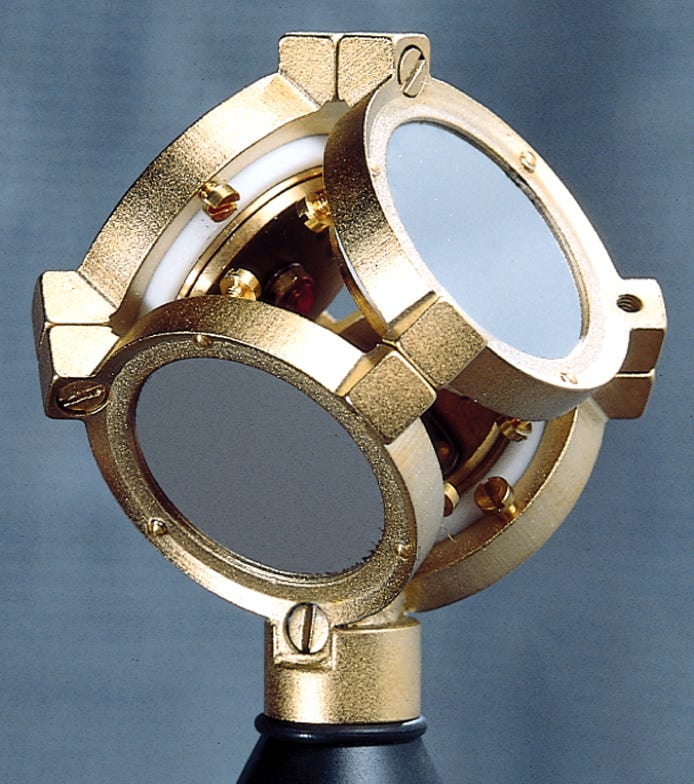
Figure 5.3 Montage tétraédrique des quatre capsules du microphone Soundfield Mk V.Figure 5.3 Tetrahedral arrangement of the four capsules of the Soundfield Mk V microphone.
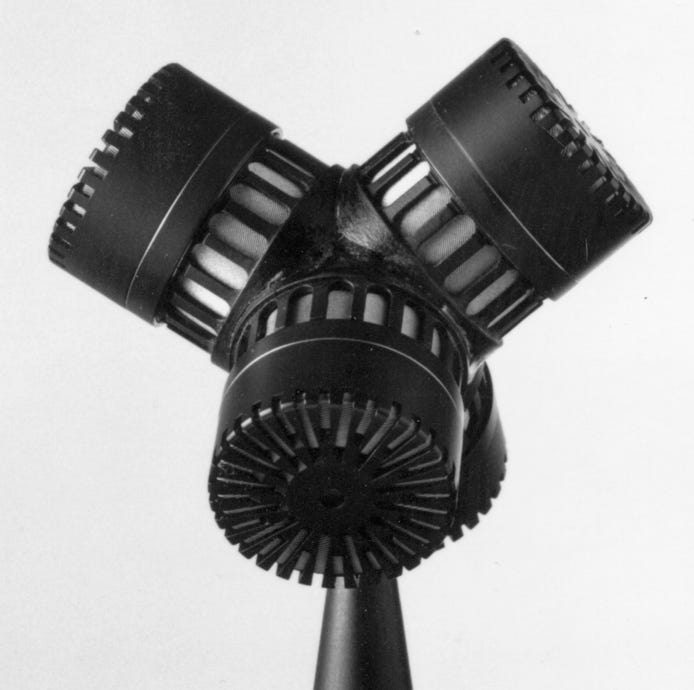
Comme nous pouvons le voir dans les figures 5.3 et 5.4, le micro de type Soundfield est constitué de quatre capsules sous-cardioïdes ou cardioïdes disposées comme sur les faces d’un tétraèdre régulier23. La sortie de ce microphone est en format-A. Avec le Soundfield Mk V, ce signal de format-A est envoyé à une unité de contrôle pour y être tout d’abord préamplifié. L’unité de contrôle94 comporte donc une entrée de micro de type DIN 12 tiges, ainsi que quatre entrées et quatre sorties de ligne de type XLR 3 tiges pour chaque canal de format-B, une sortie de ligne stéréophonique comportant deux prises de type XLR 3 tiges et une sortie de casque d’écoute de type 1/4 de pouce. Une fois que le signal du microphone est préamplifié, il est converti en format-B et corrigé de ses irrégularités de fréquences.As can be seen in figures 5.3 and 5.4, the Soundfield-type microphone consists of four subcardioid or cardioid capsules arranged as on the faces of a regular tetrahedron23. The output of this microphone is in A-format. With the Soundfield Mk V, this A-format signal is sent to a control unit to be first preamplified. The control unit94 therefore has a 12-pin DIN microphone input, as well as four 3-pin XLR line inputs and four line outputs for each B-format channel, a stereophonic line output with two 3-pin XLR connectors and a 1/4-inch headphone output. Once the microphone signal is preamplified, it is converted to B-format and corrected for its frequency irregularities.
Figure 5.4 Montage tétraédrique des quatre capsules du microphone AGM MR1.Figure 5.4 Tetrahedral arrangement of the four capsules of the AGM MR1 microphone.
L’unité de contrôle du Soundfield permet un ensemble de modifications du champ sonore en apportant des variations au format-B autant en temps réel (à la captation) qu’en différé (en postproduction). La commande Azimuth permet de faire une rotation horizontale (axes X et Y) virtuelle complète du microphone sur 360°, la commande Elevation permet de faire pivoter le microphone dans le plan médian (axes X et Z) de +/- 45° et la commande Dominance introduit une distorsion frontale ou arrière dans le champ sonore en transformant graduellement le signal W d’un omnidirectionnel à un sous-cardioïde aligné sur l’axe X. Selon la polarité de ce signal, il pointera à l’avant ou à l’arrière.The Soundfield control unit allows a range of sound field modifications by varying the B-format both in real time (during capture) and afterwards (in post-production). The Azimuth control allows a complete virtual horizontal rotation (X and Y axes) of the microphone through 360°, the Elevation control allows the microphone to be tilted in the median plane (X and Z axes) by +/- 45°, and the Dominance control introduces a frontal or rear distortion into the sound field by gradually transforming the W signal from an omnidirectional into a subcardioid aligned with the X axis. Depending on the polarity of this signal, it will point forward or backward.
Comme nous venons de le voir, la conjugaison des commandes Azimuth et Elevation permet de modifier la sphère de perception en faisant pivoter de façon virtuelle les trois axes du microphone. La commande Dominance serait en quelque sorte l’équivalent avant/arrière du contrôle de balance gauche/droit que l’on retrouve sur les préamplificateurs domestiques conventionnels. Toutes ces corrections de champ sonore se font en temps réel à la captation, avec la possibilité que le champ sonore modifié ne soit fonctionnel qu’au monitoring sans être enregistré, et en postproduction si le format-B a été complètement sauvegardé sur quatre pistes.As we have just seen, combining the Azimuth and Elevation controls makes it possible to modify the sphere of perception by virtually rotating the three axes of the microphone. The Dominance control could be seen as the front/back equivalent of the left/right balance control found on conventional home preamplifiers. All these sound field corrections can be made in real time during capture, with the option of having the modified sound field affect only the monitoring without being recorded, and in post-production if the B-format has been fully recorded on four tracks.
La dernière section de l’unité de contrôle du Soundfield permet de produire une sortie stéréophonique coïncidente. L’écartement des micros est variable de façon continue entre 0° et 180° et le caractère sphérique peut être ajusté de façon continue entre l’omnidirectionnel et le figure-huit. Puisque ces micros sont créés à partir du format-B, on peut aussi les recréer en postproduction toujours si la bande maîtresse est en format-B. Même si la section de préamplification de l’unité de contrôle est appairée à un micro avec un numéro de série en particulier, les autres commandes peuvent traiter n’importe quel format-B, qu’il soit produit par un autre micro ou qu’il soit synthétisé. Par exemple, le micro ST 250 comporte une unité de contrôle beaucoup moins axée sur l’Ambisonie. Bien que comportant une sortie en format-B, les commandes du ST 250 sont réduites à une section de production de microphones stéréo coïncidents. Tout contrôle en temps réel du champ sonore est impossible. Il faut donc le réserver à la postproduction avec l’unité de contrôle du Soundfield.The last section of the Soundfield control unit produces a coincident stereophonic output. The angle between the microphones is continuously variable between 0° and 180°, and their polar pattern can be continuously adjusted between omnidirectional and figure-of-eight. Since these microphones are created from the B-format, they can also be recreated in post-production, again provided the master tape is in B-format. Even though the preamplification section of the control unit is matched to a microphone with a particular serial number, the other controls can process any B-format, whether produced by another microphone or synthesized. For example, the ST 250 microphone has a control unit much less focused on Ambisonics. Although it has a B-format output, the controls of the ST 250 are reduced to a section producing coincident stereo microphones. Any real-time control of the sound field is impossible. It must therefore be left to post-production with the Soundfield control unit.
Comme nous l’avons noté plus haut, le système MR2 de AGM Digital93 est basé sur la même théorie que le Soundfield. Il faut donc maintenant parler du Soundfield comme un type ou une technique de captation plutôt que comme un modèle d’une compagnie en particulier. Le MR2 comporte en effet quatre capsules cardioïdes coïncidentes disposées en tétraèdre. Cependant, AGM n’a pas développé ses propres capsules, mais a utilisé des capsules déjà existantes de Brüel & Kjaer. Comme nous l’avons indiqué, la nouveauté du MR2 réside dans le traitement entièrement numérique de l’information sonore tridimensionnelle ; le signal de format-A est converti numériquement avec 20 bits de résolution dynamique et la transformation au format-B et ses manipulations potentielles subséquentes se font dans le champ d’activité numérique. Une interface-usager graphique utilisant le système d’exploitation Windows sur plate-forme IBM-PC permet les mêmes manipulations (Azimuth, Elevation et Dominance) que l’unité de contrôle du Soundfield. La sortie deux canaux standard du MR2 est aussi identique à la sortie stéréophonique que l’on retrouve sur l’unité de contrôle du Soundfield. Toutefois, lorsqu’un processeur numérique de signal est rajouté au système MR2, ce dernier permet d’encoder directement en format deux pistes UHJ101.As noted above, the MR2 system from AGM Digital93 is based on the same theory as the Soundfield. We must therefore now speak of Soundfield as a type or technique of capture rather than as a particular company’s model. The MR2 indeed has four coincident cardioid capsules arranged in a tetrahedron. However, AGM did not develop its own capsules, but used existing Brüel & Kjaer capsules. As indicated, the novelty of the MR2 lies in the entirely digital processing of three-dimensional sound information; the A-format signal is digitized with 20 bits of dynamic resolution, and the transformation to B-format and any subsequent manipulations take place in the digital domain. A graphical user interface using the Windows operating system on an IBM-PC platform allows the same manipulations (Azimuth, Elevation and Dominance) as the Soundfield control unit. The standard two-channel output of the MR2 is also identical to the stereophonic output found on the Soundfield control unit. However, when a digital signal processor is added to the MR2 system, it can encode directly into two-track UHJ format101.
5.1.2Cueillette d’échantillons avec le microphone SoundfieldCollecting samples with the Soundfield microphone
Après avoir pris connaissance de l’existence du Soundfield, il nous apparaissait important de nous en faire une opinion pour nous-mêmes, malgré les commentaires positifs qu’on retrouve dans la littérature spécialisée. L’idée était de mener une série d’enregistrements dans des environnements présentant de nombreux stimuli sonores de toute direction et d’en faire le monitoring de postproduction sur des assemblages bidimensionnels d’enceintes acoustiques et, si le temps et l’argent le permettaient, sur des assemblages tridimensionnels. Ces essais n’avaient pas un véritable caractère scientifique, quoique nous aurions recueilli les commentaires et les impressions du plus grand nombre de personnes possible, quant au réalisme spatial de la reproduction sonore des différents environnements.After learning of the existence of the Soundfield, it seemed important to us to form our own opinion of it, despite the positive comments found in the specialized literature. The idea was to make a series of recordings in environments with numerous sound stimuli from every direction, and to monitor them in post-production on two-dimensional loudspeaker arrays and, if time and money allowed, on three-dimensional arrays. These trials were not truly scientific in character, although we would have gathered the comments and impressions of as many people as possible regarding the spatial realism of the sound reproduction of the various environments.
En juin 1990, nous avons eu à notre disposition pour une période de deux semaines un micro AMS Soundfield Mk IV. Il nous a été prêté par la compagnie Adcom Electronics de Toronto, qui en était le distributeur au Canada. Pour faciliter le prêt, le micro était officiellement sous la responsabilité de l’Office national du film du Canada à Montréal. L’ONF avait loué un magnétophone analogique Studer C274 quatre pistes sur 1/4 de pouce avec Dolby HX Pro et une unité de réduction de bruit de fond DBX. Le micro venait avec sa caisse, contenant aussi l’unité de contrôle, dix mètres de câble et une prise mâle et une prise femelle XLR 5 tiges. En effet, l’unité de contrôle du modèle IV ne comportait qu’une entrée et une sortie de format XLR 5 pour le format-B. Il fallait donc fabriquer nos propres adaptateurs pour raccorder la sortie et l’entrée de format-B de l’unité de contrôle avec le magnétophone. Le microphone étant fourni sans suspension, il fallut aussi adapter une suspension de Neumann U87. Par contre, le Soundfield était fourni avec une mousse anti-vent couvrant l’ensemble du grillage. Le technicien de l’ONF jugea toutefois sa performance comme étant peu efficace et rajouta une housse Rycote à l’équipement, pour les enregistrements extérieurs.In June 1990, we had at our disposal for a period of two weeks an AMS Soundfield Mk IV microphone. It was lent to us by the company Adcom Electronics of Toronto, which was its distributor in Canada. To facilitate the loan, the microphone was officially under the responsibility of the National Film Board of Canada in Montréal. The NFB had rented a Studer C274 four-track 1/4-inch analog tape recorder with Dolby HX Pro and a DBX noise reduction unit. The microphone came with its case, which also contained the control unit, ten metres of cable and a male and a female 5-pin XLR connector. Indeed, the control unit of the Mk IV had only one 5-pin XLR input and one output for the B-format. We therefore had to make our own adapters to connect the B-format output and input of the control unit to the tape recorder. Since the microphone was supplied without a shock mount, a Neumann U87 shock mount also had to be adapted. On the other hand, the Soundfield came with a foam windscreen covering the whole grille. The NFB technician, however, judged it to be rather ineffective and added a Rycote windshield to the equipment for outdoor recordings.
Le premier enregistrement fut le concert de l’Ensemble vocal Arts-Québec pour la Fête Nationale, le 24 juin 1990. Le concert, qui avait lieu à l’église Saint-Jean-Baptiste de Montréal, comportait un répertoire varié avec des pièces de chorale a capella, avec orchestre, des pièces pour orchestre seul, pour piano solo et pour piano avec orchestre. Le micro était installé à quelques mètres de la première rangée de l’orchestre et surélevé d’environ trois mètres. Le format-B fut enregistré sans modification de champ sonore sur le magnétophone quatre pistes et le signal stéréo sur un magnétophone DAT, comme c’est l’habitude pour les concerts de l’Ensemble. Puisque cette captation avait une double fonction, nous n’avions pas le temps d’expérimenter sur place les modifications de champ sonore, on le ferait plus tard en postproduction, mais les contrôles de la sortie stéréo se sont avérés un outil des plus intéressants. Pendant la générale avant le concert, nous avons longuement testé les différents microphones virtuels pour constater que cette flexibilité et ce contrôle à distance sont un progrès notable même quand on les compare à une commande de micro M-S.The first recording was the concert of the Ensemble vocal Arts-Québec for the Fête nationale, on June 24, 1990. The concert, which took place at the Église Saint-Jean-Baptiste in Montréal, featured a varied repertoire with a cappella choral pieces, choral pieces with orchestra, pieces for orchestra alone, for solo piano and for piano with orchestra. The microphone was placed a few metres from the front row of the orchestra and raised about three metres. The B-format was recorded without sound field modification on the four-track tape recorder, and the stereo signal on a DAT recorder, as is customary for the Ensemble’s concerts. Since this recording had a dual purpose, we did not have time to experiment with sound field modifications on site, which would be done later in post-production, but the stereo output controls proved to be a most interesting tool. During the dress rehearsal before the concert, we tested the various virtual microphones at length and found that this flexibility and remote control are a notable step forward, even when compared with an M-S microphone controller.
Pour la deuxième séance d’enregistrement, le 26 juin, nous nous sommes rendus à Huntingdon pour cueillir des sons de la nature. Nous avons commencé par nous installer au bord d’une petite rivière au débit assez rapide. Ce ne fut pas nécessairement des plus captivant, ce genre de son a le fâcheux résultat de ressembler à du bruit blanc ou rose. Nous avons aussi enregistré un avion en vol. Détail anecdotique, le technicien de l’ONF gardait son vieux réflexe de vouloir pointer le microphone vers la source principale : il fallait lui rappeler constamment que le Soundfield captait le son de toutes les directions et qu’on pourrait le réorienter en postproduction. La journée s’est terminée avec l’enregistrement des chants des oiseaux au coucher du soleil. C’est sûrement l’environnement sonore le plus intéressant que nous avons capté durant cette séance. Il y avait plusieurs chants différents provenant de directions, d’élévations et de profondeurs variées, ainsi que la courbe d’une route secondaire qui apportait une ponctuation technologique occasionnelle à cette prise de son au caractère autrement bucolique.For the second recording session, on June 26, we went to Huntingdon to collect sounds of nature. We began by setting up on the bank of a small, fairly fast-flowing river. This was not necessarily the most captivating; this kind of sound has the unfortunate effect of sounding like white or pink noise. We also recorded an aircraft in flight. As an anecdote, the NFB technician kept his old reflex of wanting to point the microphone at the main source: he constantly had to be reminded that the Soundfield captured sound from every direction and that it could be reoriented in post-production. The day ended with the recording of birdsong at sunset. This was surely the most interesting sound environment we captured during this session. There were several different songs coming from various directions, elevations and depths, as well as the curve of a secondary road that provided occasional technological punctuation to this otherwise bucolic recording.
Pour l’ensemble des prises de son de cette journée, nous avons expérimenté en temps réel et en différé les modifications de champ sonore. Le monitoring se faisait au casque et nous arrêtâmes notre choix de signal stéréo sur des microphones cardioïdes virtuels écartés à environ 100°, 110°. De façon systématique, nous avons vérifié chaque commande de modification. Compte tenu des limites dans notre capacité de monitoring, c’est évidemment la commande de rotation horizontale qui produisait les effets les plus remarquables. C’est effectivement comme si nous tournions sur nous-mêmes, ce qui permettait entre autre de suivre l’avion dans son passage : après avoir ajusté la commande d’inclinaison vers le haut, la commande de rotation créait un panoramique qui gardait l’avion dans le centre du champ sonore.For all the recordings of that day, we experimented with sound field modifications both in real time and afterwards. Monitoring was done on headphones, and we settled on a stereo signal from virtual cardioid microphones spread at about 100° to 110°. We systematically checked each modification control. Given the limitations of our monitoring capabilities, it was obviously the horizontal rotation control that produced the most remarkable effects. It was indeed as if we were turning around on ourselves, which among other things made it possible to follow the aircraft as it passed: after setting the tilt control upwards, the rotation control created a pan that kept the aircraft in the centre of the sound field.
La séance suivante du 28 juin marqua notre retour à la civilisation : nous allions capter l’ambiance et les manèges du parc La Ronde, sur l’île Sainte-Hélène à Montréal. Cet environnement sonore fournissait une occasion idéale de capter des bruits de machines occupant un volume important, c’est à dire avec des informations en quantité, distribuées sur les trois axes. De plus, les réaction humaines en faisaient aussi des échantillons sonores avec une certaine charge émotive. Nous avons enregistré cinq manèges, dont deux avec quelques positions alternatives de microphone. Encore une fois, nous testions de façon systématique, durant les enregistrements, si toutes les modifications du champ sonore étaient fonctionnelles. C’était toujours, en regard de nos possibilités restreintes de monitoring, la meilleure façon de procéder pour vérifier l’intégrité du format-B. Deux des manèges que nous avons enregistrés produisaient une rotation dans le plan frontal définie par les axes Y et Z avec, comme nous le confirmait les vumètres de l’unité de contrôle, peu d’informations sur l’axe X. On pouvait donc déjà envisager de tricher, lors d’une écoute ultérieure, et de changer l’axe X pour l’axe Z à l’entrée format-B de l’unité de contrôle, pour donner un résultat impressionnant avec un décodeur bidimensionnel horizontal qui ne décoderait pas, en configuration normale, l’axe Z.The next session, on June 28, marked our return to civilization: we were going to capture the ambience and the rides of La Ronde amusement park, on Île Sainte-Hélène in Montréal. This sound environment provided an ideal opportunity to capture the noises of machines occupying a large volume, that is, with plenty of information distributed along all three axes. In addition, people’s reactions also gave these sound samples a certain emotional charge. We recorded five rides, two of them with a few alternative microphone positions. Once again, during the recordings, we systematically tested whether all the sound field modifications were working. Given our limited monitoring possibilities, this was still the best way to check the integrity of the B-format. Two of the rides we recorded produced a rotation in the frontal plane defined by the Y and Z axes with, as the VU meters of the control unit confirmed, little information on the X axis. We could therefore already consider cheating during later listening by swapping the X axis for the Z axis at the B-format input of the control unit, to give an impressive result with a horizontal two-dimensional decoder that would not, in its normal configuration, decode the Z axis.
La dernière séance d’enregistrement d’échantillons sonores constitua encore un environnement très tridimensionnel, mais aussi une occasion de vérifier les capacités dynamiques du microphone Soundfield. Le feu d’artifices de la fête du Canada, tenu le 1er juillet par la ville de Beaconsfield en banlieue de Montréal, allait sûrement pousser le microphone au bout de ses 140 dB de pression sonore maximale admissible. À une hauteur de deux mètres, nous avions installé le Soundfield à mi-chemin entre les artificiers et la foule, qui était retenue par un cordon de sécurité. Cet emplacement allait donner une bonne perspective avant/arrière avec de l’information au sol, lors du départ des fusées et les réactions de la foule, et en élévation et profondeur variées avec, évidemment, les explosions. Contrairement aux autres séances, où nous pouvions ajuster les niveaux de modulation avant l’enregistrement, il n’y avait pas de répétition avant la mise à feu, et il fallait, au meilleur de notre jugement, évaluer les niveaux qui seraient acceptables. Par trois fois durant le feu, il a fallu baisser ces niveaux pour éviter la surmodulation, car nous avions sans aucun doute sous-évalué la pression sonore de l’événement d’au moins 15 dB. Quoiqu’il en soit, le microphone a encore une fois répondu à nos attentes avec une performance irréprochable, et les tests de champ sonore ont permis d’attester de l’intégrité du format-B.The last session for recording sound samples was again a very three-dimensional environment, but also an opportunity to test the dynamic capabilities of the Soundfield microphone. The Canada Day fireworks, held on July 1 by the city of Beaconsfield in suburban Montréal, would surely push the microphone to the limit of its maximum permissible sound pressure of 140 dB. At a height of two metres, we had placed the Soundfield halfway between the pyrotechnicians and the crowd, which was held back by a security cordon. This location would give a good front/back perspective, with information at ground level from the launch of the rockets and the reactions of the crowd, and at varied elevations and depths with, of course, the explosions. Unlike the other sessions, where we could adjust the recording levels beforehand, there was no rehearsal before the firing, and we had to estimate, to the best of our judgment, which levels would be acceptable. Three times during the fireworks, these levels had to be lowered to avoid overload, as we had undoubtedly underestimated the sound pressure of the event by at least 15 dB. Be that as it may, the microphone once again met our expectations with flawless performance, and the sound field tests confirmed the integrity of the B-format.
5.1.3Écoute des échantillonsListening to the samples
La prochaine étape, après la cueillette d’échantillons sonores, était l’écoute avec un système de monitoring adéquat. Le studio de mixage IMAX de l’ONF était un choix naturel, puisque la disposition des enceintes acoustiques constituait un ensemble que les décodeurs ambisoniques couramment fabriqués pouvaient alimenter. Cependant, les techniciens de l’ONF voulaient décoder le format-B avec des matrices M-S, et j’ai donc décidé d’acquérir personnellement un décodeur ambisonique. La commande fut passée à la compagnie Minim Electronics, de Burnham en Angleterre, au mois d’août 1990. Au moment d’écrire ces lignes, nous n’avons toujours pas reçu le décodeur malgré nos rappels nombreux, voire désespérés, et les résultats de l’écoute ne peuvent donc pas être inclus dans ce mémoire.The next step, after collecting the sound samples, was listening with an appropriate monitoring system. The NFB’s IMAX re-recording mixing studio was a natural choice, since its loudspeaker arrangement was one that commonly manufactured Ambisonic decoders could feed. However, the NFB technicians wanted to decode the B-format with M-S matrices, and I therefore decided to acquire an Ambisonic decoder personally. The order was placed with the company Minim Electronics, of Burnham in England, in August 1990. At the time of writing, we have still not received the decoder despite our many, even desperate, reminders, and the results of the listening sessions therefore cannot be included in this thesis.
5.2Manipulation de signal dans l’AmbisonieSignal manipulation in Ambisonics
Compte tenu des méthodes de travail courantes dans l’industrie de la musique enregistrée, l’Ambisonie n’aurait qu’un intérêt limité s’il était impossible de créer (à l’opposition de reproduire) un champ sonore ambisonique à partir de matériel multipistes ou polymicrophonique conventionnel. Étant donné que le format-B est constitué de micros virtuels (ou réels dans le cas de la compagnie Nimbus) répondant à des fonctions mathématiques précises46, il devient relativement facile de concevoir des équipements qui répondront à ces fonctions. Notons encore que l’ordre de conception des équipements ambisoniques s’est fait à l’inverse de ce qui s’est produit avec le Dolby Stereo/Surround, où il faut maintenant imaginer des assemblages de micros qui imitent un équipement de mixage ne répondant pas à un ensemble intégré de fonctions mathématiques.Given the current working methods of the recorded music industry, Ambisonics would be of limited interest if it were impossible to create (as opposed to reproduce) an Ambisonic sound field from conventional multitrack or multi-microphone material. Since the B-format consists of virtual microphones (or real ones in the case of the Nimbus company) corresponding to precise mathematical functions46, it becomes relatively easy to design equipment that meets these functions. Let us note again that Ambisonic equipment was designed in the reverse order of what happened with Dolby Stereo/Surround, where microphone arrays must now be devised to imitate mixing equipment that does not correspond to an integrated set of mathematical functions.
Depuis le début des années 80, période où les personnes impliquées dans le projet ambisonique n’étaient pas encore trop découragées, la compagnie britannique Audio Design fabrique un certain nombre d’appareils permettant le mixage dans l’Ambisonie29. Manufacturés en petite quantité, ces appareils, contrairement au micro Soundfield, n’ont pas fait l’objet de beaucoup de tests et d’essais documentés. À notre connaissance, il y a très peu d’articles publiés au sujet du mixage ambisonique. De plus, le matériel le plus intéressant détaillant avec précision la conception et le fonctionnement de ces appareils reste sans aucun doute les rapports de recherches internes de la NRDC et de la BBC en Angleterre.Since the early eighties, when those involved in the Ambisonic project were not yet too discouraged, the British company Audio Design has manufactured a number of devices for mixing in Ambisonics29. Manufactured in small quantities, these devices, unlike the Soundfield microphone, have not been the subject of much documented testing. To our knowledge, very few articles have been published on Ambisonic mixing. Moreover, the most interesting material describing precisely the design and operation of these devices is undoubtedly the internal research reports of the NRDC and the BBC in England.
Quoiqu’il en soit, on peut quand même se faire une idée assez juste de ce qu’est un studio ambisonique.Be that as it may, one can still form a fairly accurate idea of what an Ambisonic studio is.
Mentionnons tout d’abord que les appareils de traitement ambisonique appartiennent à deux catégories : les appareils qui manipulent individuellement des sons monophoniques à l’intérieur d’un champ sonore et les appareils qui manipulent des champs sonores complets, telle l’unité de contrôle du microphone Soundfield. Dans le studio ambisonique, on retrouve donc quatre appareils de traitement de signal analogique : le B-format converter (convertisseur), le encoder/transcoder (encodeur/transcodeur), le decoder (décodeur) déjà mentionné et finalement le pan/rotate system (module de panoramique/rotation)5.Let us first mention that Ambisonic processing devices fall into two categories: devices that individually manipulate monophonic sounds within a sound field, and devices that manipulate complete sound fields, such as the control unit of the Soundfield microphone. The Ambisonic studio therefore has four analog signal-processing devices: the B-format converter, the encoder/transcoder, the decoder already mentioned and, finally, the pan/rotate system5.
Le convertisseur permet d’utiliser le contrôle de panoramique d’une console conventionnelle (dont le contrôle de panoramique suit de près une fonction sinusoïdale) pour générer un signal de format-B. On retrouve ainsi sur le convertisseur deux ensembles identiques de quatre entrées, auxquelles on assigne deux ensembles de quatre groupes de la console. Dans un ensemble, chaque paire de groupes (1-2, 2-3, 3-4, 4-1 par exemple) couvre un quadrant de 90° ; la circonférence complète de 360° est couverte par chaque ensemble de quatre groupes. Ce procédé ne résulte toutefois qu’en des signaux X et Y ; il faudra alimenter un cinquième signal au convertisseur, pour que ce dernier puisse produire à sa sortie un signal W. Celui-ci sera produit par la sommation monophonique de tous les sons assignés aux groupes de la console alimentant le convertisseur. La meilleure méthode pour générer un tel signal est d’envoyer chaque son en post-fader dans un bus d’auxiliaire. Le signal de ce bus devient alors le signal W. Toutes ces opérations peuvent se répéter, puisqu’on pourra assigner au deuxième ensemble du convertisseur quatre autres groupes pour obtenir ainsi en bout de ligne deux ensembles indépendants de « localisation statique »29, c’est-à-dire pour des sons ne demandant pas une rotation de 360° en temps réel. Dans le cas d’un mixage de musique pop, ces limites ne sont pas réellement contraignantes.The converter makes it possible to use the pan control of a conventional console (whose pan control closely follows a sine function) to generate a B-format signal. The converter thus has two identical sets of four inputs, to which two sets of four console groups are assigned. In each set, each pair of groups (1-2, 2-3, 3-4, 4-1 for example) covers a 90° quadrant; the complete 360° circumference is covered by each set of four groups. This process, however, results only in X and Y signals; a fifth signal must be fed to the converter for it to produce a W signal at its output. This will be produced by the mono sum of all the sounds assigned to the console groups feeding the converter. The best way to generate such a signal is to send each sound post-fader to an auxiliary bus. The signal of this bus then becomes the W signal. All these operations can be repeated, since four other groups can be assigned to the second set of the converter, thus ultimately obtaining two independent sets of “static localization”29, that is, for sounds not requiring a 360° rotation in real time. In the case of a pop music mix, these limitations are not really restrictive.
Si le besoin se fait sentir de donner des effets plus frappants, le module de panoramique/rotation comporte huit entrées où il est possible de produire pour chaque signal une rotation continue complète sur 360° : on peut leur assigner des entrées ou des groupes de consoles. Le type de manipulation spatiale ainsi offerte est appelé « localisation dynamique »29. Chaque entrée sur le module permet aussi de varier l’étendue spatiale du son d’un point précis à un arc diffus : en effet, les sons ne sont pas nécessairement tous concentrés en des points précis dans l’espace. Notons que le module de panoramique/rotation est le seul appareil permettant à la fois la manipulation de sons individuels et du champ sonore complet. Effectivement, la fonction de rotation permet une rotation dynamique complète de 360° du champ global : en ce sens, c’est une commande assimilable à celle d’azimut sur l’unité de contrôle du micro Soundfield.If more striking effects are needed, the pan/rotate system has eight inputs, each of which can be given a complete continuous 360° rotation: console inputs or groups can be assigned to them. The type of spatial manipulation thus offered is called “dynamic localization”29. Each input on the module also makes it possible to vary the spatial extent of the sound from a precise point to a diffuse arc: indeed, sounds are not necessarily all concentrated at precise points in space. Note that the pan/rotate system is the only device allowing the manipulation of both individual sounds and the complete sound field. Indeed, the rotation function allows a complete dynamic 360° rotation of the whole field: in this sense, it is a control comparable to the azimuth control on the Soundfield microphone control unit.
L’encodeur/transcodeur est un appareil à deux fonctions : la première est l’encodage du format-B horizontal trois canaux en format-C deux canaux, désigné comme nous l’avons déjà noté plus haut Ambisonic UHJ. C’est ce format, pour l’instant du moins, qui est destiné à la diffusion grand public. La deuxième fonction est la conversion de format quadriphonique en format 2 canaux UHJ. Dans les expériences menées en 1983, la fonction de transcodage servait en fait à inclure la réverbération au mixage final29. Cette façon de procéder suit les recommandations proposées par Audio Design dans sa documentation sur le Ambisonic Mastering Package (AMP)5. Le décodeur est le chaînon final, permettant le monitoring du mixage en format-B ou en UHJ deux canaux. Les décodeurs les plus courants peuvent alimenter quatre enceintes acoustiques et disposent d’une commande pour s’ajuster aux proportions de l’installation d’enceintes (largeur/profondeur de 1:2 à 2:1) et d’une compensation de distance si le rayon de l’installation est supérieur à trois mètres. La littérature sur l’Ambisonie mentionne couramment un décodeur pour six enceintes46, mais il ne semble jamais avoir dépassé le stade de prototype. Audio Design propose toutefois deux adaptateurs se fixant à leur décodeur : le Ambi-5 et le Ambi-897. Conçu pour l’utilisation en auditorium, ces adaptateurs produisent un signal convenant, par exemple, aux installations déjà courantes du type Dolby Stereo dans les cinémas et peuvent ainsi sonoriser adéquatement de grandes surfaces.The encoder/transcoder is a device with two functions: the first is encoding the three-channel horizontal B-format into two-channel C-format, designated, as we noted above, Ambisonic UHJ. It is this format, for the time being at least, that is intended for consumer distribution. The second function is converting quadraphonic format into two-channel UHJ format. In the experiments conducted in 1983, the transcoding function was in fact used to include reverberation in the final mix29. This approach follows the recommendations made by Audio Design in its documentation on the Ambisonic Mastering Package (AMP)5. The decoder is the final link, allowing the mix to be monitored in B-format or in two-channel UHJ. The most common decoders can feed four loudspeakers and have a control to adjust to the proportions of the loudspeaker layout (width/depth from 1:2 to 2:1) and distance compensation if the radius of the layout is greater than three metres. The literature on Ambisonics commonly mentions a decoder for six loudspeakers46, but it seems never to have gone beyond the prototype stage. Audio Design does, however, offer two adapters that attach to its decoder: the Ambi-5 and the Ambi-897. Designed for use in auditoriums, these adapters produce a signal suitable, for example, for the Dolby Stereo-type installations already common in cinemas, and can thus adequately cover large areas.
Les appareils de la compagnie Audio Design ne représentent toutefois qu’une partie des possibilités de manipulations initialement prévues dans l’Ambisonie. L’objectif premier était en effet la réalisation d’une console ambisonique qui incluerait bien plus que ce qui est possible avec les appareils de traitement qui sont actuellement manufacturés. Un document interne de la NRDC44 établit une liste des manipulations possibles sans toutefois entrer dans les détails techniques ou les formules mathématiques permettant ces manipulations. Il y aurait tout d’abord le panoramiqueur (pan-pot) sphérique : celui-ci permet de manipuler les sons sur les trois axes spatiaux. Un manche à balai (joystick) contrôle les axes X et Y, tout en permettant aussi des effets de perception sonore vers l’intérieur du champ sonore en plaçant le manche vers le centre de sa course. Le contrôle de l’axe Z se ferait par un potentiomètre linéaire divisé au centre de sa course. Le panoramiqueur sphérique est donc un localisateur dynamique ; à cet égard, on remarque que la catégorisation de localisation statique et localisation dynamique est inexistante dans le document de la NRDC. Cette catégorisation est probablement issue des limites technologiques et financières qui existaient à la fin des années soixante-dix. Il est en effet discutable, au niveau du design industriel et de ses conséquences sur l’utilisation du produit, d’avoir des catégories de qualité pour une technologie avancée qui n’est de toute façon pas destinée au marché domestique. Ainsi, le panoramiqueur sphérique est en soi complet et n’est secondé que par un autre manipulateur en ce qui a trait au positionnement des sons monophoniques dans l’espace.The devices of the Audio Design company, however, represent only part of the possibilities for manipulation originally envisaged in Ambisonics. The primary objective was indeed to build an Ambisonic console that would include much more than is possible with the processing devices currently manufactured. An internal NRDC document44 lists the possible manipulations without, however, going into the technical details or the mathematical formulas allowing these manipulations. First, there would be the spherical pan-pot: this allows sounds to be manipulated along the three spatial axes. A joystick controls the X and Y axes, while also allowing effects of sound perception towards the inside of the sound field by placing the stick towards the centre of its travel. The Z axis would be controlled by a linear fader divided at the centre of its travel. The spherical pan-pot is therefore a dynamic localizer; in this respect, it should be noted that the categorization into static localization and dynamic localization does not exist in the NRDC document. This categorization probably stems from the technological and financial limitations that existed in the late seventies. It is indeed debatable, in terms of industrial design and its consequences for the use of the product, to have quality categories for an advanced technology that is not in any case intended for the home market. Thus, the spherical pan-pot is complete in itself and is assisted by only one other manipulator as regards the positioning of monophonic sounds in space.
L’étireur (spreader) est une variation du panoramiqueur sphérique qui pourra étirer un son à partir de sa position principale. L’étireur divise le son en différents secteurs de fréquences qui seront plus ou moins distribués de part et d’autre de la position principale déterminée par le pan-pot sphérique. L’étireur standard pourrait distribuer le son jusqu’à former un arc de 180° ou, dans sa version wrap around, distribuer le son sur une spirale qui ferait plusieurs fois le tour du champ sonore pour l’ensemble des fréquences audibles.The spreader is a variation of the spherical pan-pot that can spread a sound out from its main position. The spreader divides the sound into different frequency ranges that will be distributed to a greater or lesser extent on either side of the main position determined by the spherical pan-pot. The standard spreader could distribute the sound to form an arc of up to 180° or, in its wrap-around version, distribute the sound along a spiral that would go around the sound field several times over the whole range of audible frequencies.
Reste la manipulation globale de champ complet. Préférablement, celle-ci est possible sur les trois axes et doit être continue : le contrôleur par quadrant de 90° de champ horizontal du micro Soundfield qu’on a vu jusqu’en 1991 était donc une matérialisation fort incomplète des idées initiales dans la conception de l’Ambisonie. Encore une fois, les développements technologiques récents commencent seulement à permettre d’exploiter toutes les possibilités de manipulation. Avec un contrôleur continu de champ sphérique, les effets de zoom, qui sont possibles à l’horizontale en corrompant le signal W avec du signal X dans l’unité de contrôle du micro Soundfield, seraient possibles dans tous les azimuts et élévations.There remains the global manipulation of the complete field. Preferably, this should be possible on all three axes and be continuous: the Soundfield microphone’s controller by 90° quadrants of the horizontal field, seen until 1991, was therefore a very incomplete embodiment of the original ideas behind the design of Ambisonics. Once again, recent technological developments are only beginning to allow all the possibilities of manipulation to be exploited. With a continuous spherical field controller, zoom effects, which are possible horizontally by corrupting the W signal with X signal in the Soundfield microphone control unit, would be possible at all azimuths and elevations.
5.2.1Manipulation numérique des champs sonores ambisoniquesDigital manipulation of Ambisonic sound fields
L’équipement que nous venons de décrire est constitué d’appareils effectuant des traitements de signaux purement analogiques et ce, sans aucune forme d’automatisation ou de support informatique. Il est facilement envisageable, dans le contexte d’un mixage ambisonique horizontal complexe ou même d’un mixage ambisonique tridimensionnel relativement simple, que la capacité de manipulation de l’opérateur se révèle rapidement insuffisante. La conception d’équipement informatique permettant une manipulation de signal sous forme numérique, comportant une certaine forme d’automatisation et une interface-usager plus conviviale, devient une obligation. Rien qu’au chapitre de l’interface-usager, on n’a qu’à penser à la crainte qu’inspire souvent aux novices une console de studio le moindrement élaborée. Compte tenu de ce besoin pressant, toute la question de la manipulation numérique ambisonique a été abordée par des membres du Studio de musique électronique de l’Université de York en Angleterre. Après s’être familiarisés avec l’Ambisonie, ceux-ci ont toujours cru qu’elle était idéale pour la performance en concert et la diffusion d’enregistrements de musique électroacoustique68.The equipment we have just described consists of devices performing purely analog signal processing, without any form of automation or computer support. It is easy to imagine that, in the context of a complex horizontal Ambisonic mix or even a relatively simple three-dimensional Ambisonic mix, the operator’s capacity for manipulation would quickly prove insufficient. Designing computer equipment that allows signal manipulation in digital form, with some form of automation and a more user-friendly interface, becomes a necessity. As regards the user interface alone, one need only think of the apprehension that even a moderately elaborate studio console often inspires in novices. Given this pressing need, the whole question of digital Ambisonic manipulation was taken up by members of the Electronic Music Studio of the University of York in England. Having become familiar with Ambisonics, they have always believed that it is ideal for concert performance and for the playback of electroacoustic music recordings68.
Dave Malham a d’abord travaillé à partir de 1981 sur un contrôleur de champ ambisonique programmable numériquement67 ; l’équivalent automatisé du contrôleur de champ sur l’unité de contrôle du micro Soundfield. À partir du milieu des années 80, ses recherches se sont axées davantage vers la deuxième catégorie d’appareils telle que définie plus haut, c’est-à-dire l’automatisation de la manipulation de sons individuels dans le champ ambisonique68. Le prototype issu de ces expériences a résulté en un certain nombre d’observations sur la manipulation numérique spatiale des sons. La première inconnue concernait la puissance des convertisseurs analogique/numérique employés, et leur impact sur la résolution du champ sonore simulé. Si des restrictions budgétaires ont initialement limité les convertisseurs à n’avoir que 15 bits, les tests semblent avoir démontré que 12 bits par canal de format-B étaient suffisants et ne produisaient pas de « granulation »68 (son qui saute d’une position à l’autre plutôt que de décrire un mouvement continu) audible du champ sonore. Même que dans l’éventualité d’un champ sonore statique, des convertisseurs 8 bits seraient adéquats. L’explication semble résider dans le fait que les canaux du format-B sont reliés entre eux (un son donné sera toujours défini par un minimum de deux canaux) et qu’ainsi la résolution de chaque canal s’additionne aux résolutions des autres canaux impliqués dans le positionnement d’un son.From 1981, Dave Malham first worked on a digitally programmable Ambisonic field controller67; the automated equivalent of the field controller on the Soundfield microphone control unit. From the mid-eighties, his research focused more on the second category of devices defined above, that is, automating the manipulation of individual sounds in the Ambisonic field68. The prototype resulting from these experiments led to a number of observations on the digital spatial manipulation of sounds. The first unknown concerned the resolution of the analog-to-digital converters used and its impact on the resolution of the simulated sound field. Although budget restrictions initially limited the converters to 15 bits, tests seem to have shown that 12 bits per B-format channel were sufficient and did not produce audible “graininess”68 (sound jumping from one position to another rather than describing a continuous movement) in the sound field. Indeed, in the case of a static sound field, 8-bit converters would be adequate. The explanation seems to lie in the fact that the B-format channels are interrelated (a given sound will always be defined by at least two channels), and thus the resolution of each channel adds to the resolutions of the other channels involved in positioning a sound.
Une deuxième question concernait la vitesse à laquelle un son pouvait se déplacer, avant que ce déplacement ne soit perçu comme une modulation spectrale de la source sonore. Nous présumons que les mesures ont été effectuées pour des rotations complètes sur 360° dans le champ sonore puisque cette vitesse a été évaluée entre « 10 et 15 Hz »68 : lorsque la vitesse d’une source sonore en rotation dépasse environ dix rotations de 360° par seconde, il se produirait une modulation spectrale de la source sonore. La référence n’est pas très claire à ce chapitre. Quoiqu’il en soit, ce type d’expérience aurait été impossible avec les appareils de manipulation analogique originaux, dans ce cas-ci le module de panoramique/rotation. La dernière observation documentée concerne la résolution nécessaire pour définir adéquatement un mouvement qui suit un arc. Ayant trébuché sur un bogue de programmation, Malham dut se contenter de programmer une suite de mouvements successifs en ligne droite pour définir un arc. Il fut constaté que le système auditif humain était, à toutes fins utiles, incapable de faire la différence dans l’Ambisonie entre un mouvement vraiment circulaire et une suite de segments droits échantillonnant un mouvement circulaire. On peut s’interroger à savoir s’il s’agit d’une limite de notre système auditif ou de l’Ambisonie.A second question concerned how fast a sound could move before the movement was perceived as a spectral modulation of the sound source. We assume that the measurements were made for complete 360° rotations in the sound field, since this speed was estimated at between “10 and 15 Hz”68: when the speed of a rotating sound source exceeds about ten 360° rotations per second, a spectral modulation of the sound source would occur. The reference is not very clear on this point. Be that as it may, this type of experiment would have been impossible with the original analog manipulation devices, in this case the pan/rotate system. The last documented observation concerns the resolution needed to adequately define a movement following an arc. Having stumbled on a programming bug, Malham had to make do with programming a series of successive straight-line movements to define an arc. It was found that the human auditory system was, for all practical purposes, unable to tell the difference in Ambisonics between a truly circular movement and a series of straight segments sampling a circular movement. One may wonder whether this is a limitation of our auditory system or of Ambisonics.
Ces expériences, rappelons-le, manipulaient des signaux analogiques. Idéalement, les signaux, tout comme le contrôleur, devraient être entièrement numériques. De cette manière, le traitement numérique ne toucherait pas seulement la position et le déplacement des sources sonores, mais aussi la simulation de réflexions et de réverbération pour générer un champ sonore ambisonique plus réaliste, et moins sujet aux variations de reproduction conséquentes aux irrégularités des installations d’enceintes acoustiques. Il va en effet de soi que, pour égaler la performance du micro Soundfield au chapitre du réalisme sonore, le champ ambisonique artificiellement généré doit inclure l’ensemble des indices acoustiques, de direction et de distance des sources sonores, retrouvés dans la réalité.These experiments, let us recall, manipulated analog signals. Ideally, the signals, like the controller, should be entirely digital. In this way, digital processing would affect not only the position and movement of sound sources, but also the simulation of reflections and reverberation to generate a more realistic Ambisonic sound field, less subject to variations in reproduction resulting from irregularities in loudspeaker installations. It goes without saying that, to match the performance of the Soundfield microphone in terms of sound realism, the artificially generated Ambisonic field must include all the acoustic cues of direction and distance of sound sources found in reality.
Le besoin de traitement entièrement numérique est maintenant satisfait par la carte TMS-320c30 de AGM. C’est la carte que l’on retrouve dans l’unité de contrôle du MR2 de AGM95et plusieurs cartes de ce type ont été installées avec une console Neve VRP Legend au studio Touchdown de Munich73. On peut donc, avec cette console, faire des manipulations de champs sonores de format-B ou, si nécessaire, en Dolby Stereo. L’avantage est que le hardware est intégré et que l’utilisation gagne une certaine transparence.The need for entirely digital processing is now met by AGM’s TMS-320c30 board. This is the board found in the control unit of AGM’s MR295and several boards of this type have been installed with a Neve VRP Legend console at the Touchdown studio in Munich73. With this console, B-format sound fields can therefore be manipulated or, if necessary, Dolby Stereo. The advantage is that the hardware is integrated and that use gains a certain transparency.
5.3L’Ambisonie dans la production et la postproduction sonores au cinémaAmbisonics in film sound production and post-production
Une des raisons qui avait poussé les gens de l’Office national du film sur la voie d’une collaboration avec nous, était qu’eux-mêmes manifestaient depuis un certain temps un intérêt pour le micro Soundfield et qu’ils espéraient l’utiliser éventuellement pour enregistrer les trames sonores d’ambiance pour les films de format IMAX produits par l’ONF. Étant donné que la série d’enregistrements de l’été 1990 avait donné de bons résultats, il ont acquis le Soundfield et ont décidé de l’utiliser en grande première pour le film Momentum, qui allait être présenté à l’Exposition universelle de Séville en Espagne à l’été 1992. Fait surprenant cependant, la décision d’acquérir le Soundfield a été prise à la suite de séances d’écoute où le format-B avait été décodé avec deux matrices M-S **. Un tel décodage peut fonctionner ; il faut toutefois réaliser que les signaux ainsi produits ne peuvent être destinés à des canaux spatialement adjacents. Parce que le canal W est un omnidirectionnel, on obtiendra, par la combinaison dans une matrice M-S des canaux W et X ou W et Y, des signaux qui doivent alimenter des enceintes acoustiques séparées par un angle de 180°. Toute autre disposition résultera en une distorsion spatiale de l’acoustique originale. Quoiqu’il en soit, un décodage approprié serait la règle en cours de production.One of the reasons that led the people at the National Film Board to collaborate with us was that they themselves had for some time been interested in the Soundfield microphone and hoped eventually to use it to record the ambience soundtracks for the IMAX-format films produced by the NFB. Since the series of recordings in the summer of 1990 had given good results, they acquired the Soundfield and decided to use it for the first time on the film Momentum, which was to be presented at the Universal Exposition in Seville, Spain, in the summer of 1992. Surprisingly, however, the decision to acquire the Soundfield was made following listening sessions in which the B-format had been decoded with two M-S matrices *. Such decoding can work; it must be realized, however, that the signals thus produced cannot be intended for spatially adjacent channels. Because the W channel is omnidirectional, combining the W and X or W and Y channels in an M-S matrix will produce signals that must feed loudspeakers separated by an angle of 180°. Any other arrangement will result in spatial distortion of the original acoustics. Be that as it may, appropriate decoding would be the rule during production.
Pour la cueillette des ambiances, un magnétophone analogique Studer C278 huit pistes sur demi-pouce avec unité de réduction de bruit de fond Dolby SR allait être utilisé pour enregistrer le format-B du micro Soundfield ***. Les caméras IMAX ont la réputation d’être très bruyantes, mais la nouvelle caméra IMAX à 48 images/secondes employée en première pour le tournage de Momentum était pire encore. Ce qui devenait évident était l’impossibilité d’enregistrer les ambiances sonores simultanément avec les images. Par suite de contraintes d’horaires, certaines ambiances ont même été enregistrées à des endroits différents de ceux des images qu’elles devaient accompagner. On devait ainsi s’assurer que les ambiances ne comportaient pas de sons ponctuels pouvant être associés à des actions particulières sur l’image. La bande fut montée et ensuite transférée sur une bande multipistes pour le mixage final. Jusqu’ici, rien de bien nouveau comparé aux techniques habituelles, si ce n’est qu’avec le format-B, on travaillait toujours quatre pistes à la fois. C’est au mixage que ça se corse.For collecting the ambiences, a Studer C278 eight-track half-inch analog tape recorder with a Dolby SR noise reduction unit was to be used to record the B-format of the Soundfield microphone **. IMAX cameras have a reputation for being very noisy, but the new 48 frames/second IMAX camera used for the first time in the shooting of Momentum was even worse. What became obvious was that it was impossible to record the sound ambiences simultaneously with the images. Owing to scheduling constraints, some ambiences were even recorded in places different from those of the images they were to accompany. It therefore had to be ensured that the ambiences contained no discrete sounds that could be associated with particular actions in the picture. The tape was edited and then transferred to a multitrack tape for the final mix. So far, nothing very new compared with the usual techniques, except that with the B-format one always worked with four tracks at a time. It is in the mix that things get complicated.
Il fallait d’abord produire un signal de format-D (pour les enceintes acoustiques) particulier à la disposition des cinémas IMAX. On retrouve dans ces cinémas un ensemble d’enceintes acoustiques alimenté par six canaux discrets. Il y a bien sûr l’enceinte centrale derrière l’écran, pour la narration et les dialogues, et les enceintes avant-gauche et avant-droit, aussi derrière l’écran. Dans la salle proprement dite, plutôt qu’une ceinture d’enceintes acoustiques comme en Dolby Stereo, deux enceintes à large dispersion se retrouvent dans les coins arrières. En oubliant l’enceinte centrale, qui de toute façon est alimentée par un canal qui lui est propre, la disposition décrite d’enceintes dessinant un rectangle convient parfaitement au format-D produit par les décodeurs ambisoniques disponibles à cette époque. Reste un canal qui alimente une autre enceinte centrale derrière l’écran, mais installée au sommet de celui-ci. On constate donc que la disposition des enceintes acoustiques dans les salles IMAX peut reproduire un espace sonore tridimensionnel selon les critères établis au troisième chapitre. Cependant, puisque la majorité des enceintes sont au-dessus de l’auditoire, l’impression auditive du champ sonore tridimensionnel n’est pas optimale.First, a D-format signal (for the loudspeakers) specific to the layout of IMAX theatres had to be produced. These theatres have a set of loudspeakers fed by six discrete channels. There is of course the centre loudspeaker behind the screen, for narration and dialogue, and the front-left and front-right loudspeakers, also behind the screen. In the auditorium itself, rather than a ring of loudspeakers as in Dolby Stereo, two wide-dispersion loudspeakers are located in the rear corners. Leaving aside the centre loudspeaker, which in any case is fed by its own channel, the arrangement of loudspeakers described, forming a rectangle, is perfectly suited to the D-format produced by the Ambisonic decoders available at that time. There remains one channel that feeds another centre loudspeaker behind the screen, but installed at the top of it. The loudspeaker layout in IMAX theatres can therefore reproduce a three-dimensional sound space according to the criteria established in the third chapter. However, since most of the loudspeakers are above the audience, the auditory impression of the three-dimensional sound field is not optimal.
Comme nous l’avons écrit plus haut, il n’y avait pas de décodeur sur le marché utilisant le format-B dans sa totalité : le signal Z est éliminé et on ne traite qu’un champ bidimensionnel. Pour la disposition IMAX, il est relativement facile de contourner le problème en alimentant le format-B à un deuxième décodeur, mais en prenant soin de substituer le signal Y par le signal Z. On obtient alors un plan sonore vertical correspondant au plan médian de la figure 1.1. Dans ce plan sonore, l’enceinte acoustique du sommet de l’écran correspond au signal avant gauche du format-D. Le double décodage bidimensionnel constitue alors ce que nous appellerons le format-D IMAX. Ce signal à cinq canaux peut être alors mixé, de manière habituelle au mixage sonore pour les films IMAX, avec les autres éléments de la trame sonore comme les dialogues, les sons ponctuels et la musique. Il serait important de souligner ici que les cinq canaux du format-D IMAX doivent être considérés comme un tout. Durant le mixage, toute modification du ratio du format-D IMAX dans le mixage total doit se traduire par un changement simultané et identique des cinq canaux constituant le format-D IMAX, pour éviter la distorsion spatiale du champ sonore.As we wrote above, there was no decoder on the market using the B-format in its entirety: the Z signal is eliminated and only a two-dimensional field is processed. For the IMAX layout, it is relatively easy to get around the problem by feeding the B-format to a second decoder, taking care to substitute the Z signal for the Y signal. This gives a vertical sound plane corresponding to the median plane of figure 1.1. In this sound plane, the loudspeaker at the top of the screen corresponds to the front-left signal of the D-format. The double two-dimensional decoding then constitutes what we will call the IMAX D-format. This five-channel signal can then be mixed, in the usual way for IMAX film re-recording mixing, with the other elements of the soundtrack such as dialogue, discrete sounds and music. It is important to stress here that the five channels of the IMAX D-format must be considered as a whole. During re-recording mixing, any change in the proportion of the IMAX D-format in the overall mix must result in a simultaneous and identical change in the five channels making up the IMAX D-format, to avoid spatial distortion of the sound field.
Mais avant même de mixer le format-D IMAX avec le reste de la trame sonore, il fallait trouver une méthode pour mixer les champs sonores ambisoniques entre eux. Pour certaines scènes, il pouvait y avoir un fondu enchaîné entre deux champs sonores et même, dans certains cas, qui se superposaient complètement le temps de la scène. L’équipe de mixage de l’ONF a choisi de mixer les champs sonores après leur conversion en format-D IMAX ****. Concrètement, ceci voulait dire l’utilisation simultanée de jusqu’à quatre décodeurs. Ces quatre décodeurs permettaient en fait plusieurs scénarios de mixage.But even before mixing the IMAX D-format with the rest of the soundtrack, a method had to be found to mix the Ambisonic sound fields with one another. For some scenes, there could be a crossfade between two sound fields and even, in some cases, fields completely superimposed for the duration of the scene. The NFB re-recording mixing team chose to mix the sound fields after their conversion into IMAX D-format ***. In concrete terms, this meant the simultaneous use of up to four decoders. These four decoders in fact allowed several mixing scenarios.
D’après ce qu’on a décrit plus haut, le mixage de deux format-D IMAX complet avec deux décodeurs pour chaque champ est ce qui paraît immédiatement évident. Cependant, certains champs sonores présentent peu d’information verticale : il n’est donc plus nécessaire de monopoliser un décodeur pour produire le format-D de l’enceinte produisant cette dimension. On peut alors mixer trois champs sonores, un complet et deux bidimensionnels, ou encore quatre champs bidimensionnels. Il va de soi que la remarque faite au paragraphe précédent sur l’intégrité des champs sonores tient toujours : les quatre ou cinq signaux de chaque format-D forment un tout qu’il faut mixer de façon globale. Pour Momentum, toutes les combinaisons de décodeurs ont été exploitées. Une fois la trame sonore finale à six pistes terminée, elle est transférée sur trois disques compacts numériques qui seront reproduits simultanément lors du visionnement : chaque disque ne comportant en effet que deux pistes audio et une piste de synchronisation.From what has been described above, mixing two complete IMAX D-formats with two decoders for each field is what seems immediately obvious. However, some sound fields have little vertical information: it is therefore no longer necessary to tie up a decoder to produce the D-format for the loudspeaker reproducing this dimension. One can then mix three sound fields, one complete and two two-dimensional, or four two-dimensional fields. It goes without saying that the remark made in the previous paragraph on the integrity of sound fields still holds: the four or five signals of each D-format form a whole that must be mixed globally. For Momentum, all the combinations of decoders were used. Once the final six-track soundtrack is completed, it is transferred to three digital compact discs that are played simultaneously during the screening: each disc having only two audio tracks and one synchronization track.
D’après les réactions initiales des différents intervenants de l’Office national du film qui ont eu à travailler avec la technologie du microphone Soundfield et de l’Ambisonie, les résultats sont très encourageants *****. Pour ce qui est de la reproduction des ambiances, les performances de l’Ambisonie sont autrement supérieures à celles du système Dolby Stereo standard et même du système Dolby Stereo à six canaux. Les responsables de la compagnie IMAX se sont aussi montrés très intéressés et satisfaits. Tout ce qu’on peut espérer maintenant, c’est que IMAX adopte l’Ambisonie comme système standard de production et de diffusion sonores.According to the initial reactions of the various people at the National Film Board who worked with Soundfield microphone and Ambisonic technology, the results are very encouraging ****. As regards the reproduction of ambiences, the performance of Ambisonics is far superior to that of the standard Dolby Stereo system and even of the six-channel Dolby Stereo system. The people in charge at the IMAX company were also very interested and satisfied. All that can be hoped for now is that IMAX adopts Ambisonics as its standard sound production and playback system.
À la lumière de cette expérience d’intégration de l’Ambisonie au cinéma IMAX, deux recommandations nous viennent immédiatement à l’esprit, afin que les expériences subséquentes soient encore plus fructueuses. La technique de mixage ambisonique employé à l’ONF illustre de manière assez claire l’incompréhension de ce système. Le mixage normal en stéréophonie fait que l’on manipule toujours un signal qui peut être directement écouté ; il est normal de vouloir perpétuer ces méthodes même si l’Ambisonie est foncièrement différente de la stéréophonie conventionnelle. En Ambisonie, tout le traitement de signal s’opère au niveau du format-B qui, nous l’avons déjà dit, ne peut être directement écouté. Le mixage des différentes ambiances entre elles aurait dû se faire en format-B. Le mixage en format-D pour le film Momentum est-il le résultat de limitations techniques ? Les responsables l’ont peut-être crû, mais dans les faits il n’en n’est rien. Comme ils l’ont fait pour mixer le format-D, ils auraient pu se servir d’une console conventionnelle pour mixer le format-B et décoder en une seule fois le résultat du mixage en format-D. Les précautions que les techniciens de mixage ont prises dans la production de Momentum auraient été les mêmes, c’est-à-dire traiter les quatre canaux constituant chaque ambiance en format-B comme un signal unique. En appliquant le mixage de format-B, et compte tenu de la disposition des enceintes acoustiques des salles IMAX et des limitations des décodeurs disponibles, seulement deux décodeurs auraient été nécessaires pour obtenir un format-D tridimensionnel en tout temps.In the light of this experience of integrating Ambisonics into IMAX cinema, two recommendations immediately come to mind, so that subsequent experiments may be even more fruitful. The Ambisonic re-recording mixing technique used at the NFB illustrates quite clearly a misunderstanding of this system. Normal stereophonic mixing means that one always manipulates a signal that can be listened to directly; it is natural to want to perpetuate these methods even though Ambisonics is fundamentally different from conventional stereophony. In Ambisonics, all signal processing takes place at the B-format level which, as we have already said, cannot be listened to directly. The various ambiences should have been mixed together in B-format. Was the re-recording mixing in D-format for the film Momentum the result of technical limitations? Those in charge may have believed so, but in fact this is not the case. Just as they did to mix the D-format, they could have used a conventional console to mix the B-format and decoded the result of the mix into D-format in a single pass. The precautions taken by the re-recording mixing technicians in the production of Momentum would have been the same, that is, treating the four channels making up each ambience in B-format as a single signal. By applying B-format mixing, and given the loudspeaker layout of IMAX theatres and the limitations of the available decoders, only two decoders would have been needed to obtain a three-dimensional D-format at all times.
La deuxième recommandation concerne plus la compagnie IMAX proprement dite. Si elle venait à adopter l’Ambisonie comme standard sonore, il faudrait mettre de côté le principe d’enregistrer sur le support sonore final des signaux prêts à être diffusés par les enceintes acoustiques. En termes ambisoniques, cela veut dire que le support final devrait y voir inscrit le format-C et non le format-D. Comme nous l’avons indiqué plus haut, le format-C est le format de transmission de l’Ambisonie. Dans le cas de IMAX, le format-C pourrait être en fait une copie exacte du format-B du mixage final ou une conversion UHJ à quatre canaux. On pourrait toujours laisser une piste indépendante pour l’enceinte acoustique des narrations et dialogues, ce qui combiné au format-C donnerait cinq pistes. Ainsi, avec une piste de moins que le standard actuel de six pistes, les résultats seraient identiques sinon meilleurs. Ceci impliquerait toutefois, comme le veut la philosophie derrière l’Ambisonie, que chaque salle IMAX ait son propre décodeur. L’avantage serait que les décodeurs seraient ajustés aux variations de dispositions que l’on peut retrouver d’une salle à l’autre et signifierait même qu’un seul mixage final pourrait être utilisé autant dans les salles IMAX que dans les salles Omnimax, qui ont une installation sonore passablement différente des salles IMAX.The second recommendation concerns the IMAX company itself. If it were to adopt Ambisonics as its sound standard, the principle of recording on the final sound medium signals ready to be played by the loudspeakers would have to be set aside. In Ambisonic terms, this means that the C-format, and not the D-format, should be recorded on the final medium. As indicated above, the C-format is the transmission format of Ambisonics. In the case of IMAX, the C-format could in fact be an exact copy of the B-format of the final mix or a four-channel UHJ conversion. An independent track could always be left for the narration and dialogue loudspeaker, which, combined with the C-format, would give five tracks. Thus, with one track fewer than the current six-track standard, the results would be identical if not better. This would, however, imply, as the philosophy behind Ambisonics requires, that each IMAX theatre have its own decoder. The advantage would be that the decoders would be adjusted to the variations in layout that can be found from one theatre to another, and would even mean that a single final mix could be used both in IMAX theatres and in Omnimax theatres, whose sound installation is quite different from that of IMAX theatres.
5.4Performances de l’AmbisoniePerformance of Ambisonics
John Vanderkooy et Stanley Lipshitz, de l’Université de Waterloo en Ontario, ont procédé à une analyse de l’Ambisonie84. Leur constat de base était qu’en reproduction stéréophonique conventionnelle à deux enceintes acoustiques, la relation entre la pression acoustique et la vélocité des particules est généralement faussée. C’est que « la pression acoustique totale est la somme scalaire des pressions produites par les deux enceintes acoustiques, tandis que la vélocité des particules est la somme vectorielle des vélocités produites par les deux enceintes »84. En d’autres termes, le déplacement d’une source sonore fantôme entre les enceintes acoustiques produira une augmentation de pression, mais la vélocité des particules n’augmentera pas. Une source sonore fantôme située entre les deux enceintes produira une pression sonore supérieure à celle qui serait produite si la source sonore venait strictement de l’enceinte gauche ou droite. En situation réelle, dans la mesure où l’émission acoustique est stable dans tous ses paramètres, le déplacement d’une source sonore ne produira pas d’augmentation de pression. On remarquera ainsi que la seule prise de son stéréophonique qui est exempte de ce défaut est la captation Blumlein, où deux micros figure-huit se croisent à 90°.John Vanderkooy and Stanley Lipshitz, of the University of Waterloo in Ontario, carried out an analysis of Ambisonics84. Their basic finding was that, in conventional two-loudspeaker stereophonic reproduction, the relationship between acoustic pressure and particle velocity is generally incorrect. This is because “the total acoustic pressure is the scalar sum of the pressures produced by the two loudspeakers, whereas the particle velocity is the vector sum of the velocities produced by the two loudspeakers”84. In other words, moving a phantom sound source between the loudspeakers will produce an increase in pressure, but the particle velocity will not increase. A phantom sound source located between the two loudspeakers will produce a higher sound pressure than would be produced if the sound source came strictly from the left or right loudspeaker. In a real situation, provided the acoustic emission is stable in all its parameters, moving a sound source will not produce an increase in pressure. It will thus be noted that the only stereophonic recording technique free of this defect is the Blumlein pair, in which two figure-of-eight microphones cross at 90°.
Puisque l’information directionnelle du format-B dans l’Ambisonie est constituée de trois figure-huit à 90° les uns par rapport aux autres, le système permet de rétablir une relation adéquate entre la pression acoustique et la vélocité des particules. Cependant, selon la méthode employé par Vanderkooy et Lipshitz, la décomposition en harmoniques sphériques du signal acoustique reproduit par l’Ambisonie permet de constater que la forme de l’onde acoustique reproduite sera une copie de l’originale seulement dans une position d’écoute située au centre de l’installation d’enceintes acoustiques et pour des fréquences inférieures à 700 Hz.Since the directional information of the B-format in Ambisonics consists of three figure-of-eights at 90° to one another, the system makes it possible to restore an adequate relationship between acoustic pressure and particle velocity. However, according to the method used by Vanderkooy and Lipshitz, decomposing the acoustic signal reproduced by Ambisonics into spherical harmonics shows that the shape of the reproduced acoustic wave will be a copy of the original only at a listening position at the centre of the loudspeaker layout and for frequencies below 700 Hz.
Dans une autre opinion sur l’Ambisonie, Cooper fait remarquer les mêmes limitations, mais tout en soulignant que l’Ambisonie est le seul système, à l’intérieur de ces limites, à pouvoir reproduire un espace acoustique vraiment tridimensionnel19. Comme le font remarquer Vanderkooy et Lipshitz, à partir du moment où la position d’écoute n’est pas optimisée au centre, des distorsions importantes dans la forme de l’onde parvenant à l’auditeur se remarquent. À l’instar de Malham68, Vanderkooy et Lipshitz suggèrent fortement l’implantation d’un système ambisonique de deuxième génération qui incorporerait dans le format-B des micro virtuels correspondants à l’harmonique sphérique de deuxième ordre.In another opinion on Ambisonics, Cooper points out the same limitations, while stressing that Ambisonics is the only system, within these limits, able to reproduce a truly three-dimensional acoustic space19. As Vanderkooy and Lipshitz point out, as soon as the listening position is not optimized at the centre, significant distortions can be observed in the shape of the wave reaching the listener. Like Malham68, Vanderkooy and Lipshitz strongly suggest the introduction of a second-generation Ambisonic system that would incorporate into the B-format virtual microphones corresponding to the second-order spherical harmonic.
En 1973 et 1974, Gerzon42 et Peter Fellgett32 évoquaient déjà cette possibilité. L’avantage d’un tel système ambisonique serait une plus grande séparation directionnelle entre les canaux, ayant comme conséquence directe une reproduction tridimensionnelle fidèle dans un plus grand volume. La nécessité d’un tel système devient évidente lorsque l’on connaît les utilisations pour lesquelles on destine maintenant l’Ambisonie : les trames sonores de cinéma ou de théâtre, les représentations publiques de musique électroacoustique, le support sonore pour expositions de tout genre. Ce sont en fait toutes des applications qui exigent une performance adéquate sur une plus grande surface ou dans un plus grand volume. Malham fait cependant remarquer que lors de tests de périphonie (terme choisi par Gerzon pour désigner la reproduction tridimensionnelle42 et repris par Malham dans son texte) menés dans une salle de cinéma en Angleterre en 1985 par la compagnie Calrec, la distorsion remarquée n’était pas nécessairement désagréable et ne nuisait pas de façon excessive à la crédibilité de la reproduction tridimensionnelle68.In 1973 and 1974, Gerzon42 and Peter Fellgett32 were already mentioning this possibility. The advantage of such an Ambisonic system would be greater directional separation between channels, with the direct consequence of faithful three-dimensional reproduction in a larger volume. The need for such a system becomes obvious when one knows the uses for which Ambisonics is now intended: film or theatre soundtracks, public performances of electroacoustic music, sound for exhibitions of all kinds. These are in fact all applications that require adequate performance over a larger area or in a larger volume. Malham points out, however, that during tests of periphony (a term chosen by Gerzon to designate three-dimensional reproduction42 and taken up by Malham in his text) conducted in a cinema in England in 1985 by the Calrec company, the distortion observed was not necessarily unpleasant and did not unduly detract from the credibility of the three-dimensional reproduction68.
Plus récemment, des membres du département de micro-électronique et ingénierie électrique du Trinity College de Dublin en Irlande ont procédé à un test comparatif entre trois systèmes de spatialisation sonore, dont l’Ambisonie bidimensionnelle sur quatre enceintes acoustiques65. Les deux autres systèmes testés étaient le Knowles Electronics Manikin for Acoustic Research (KEMAR), un système de captation binaural et le Spectral Stereo. Ce dernier est un modèle binaural simplifié utilisant une sphère sans pavillon d’oreille : la reproduction se fait aussi sur deux enceintes. L’article fait référence aux expérimentations de Cooper18 aux débuts des années quatre-vingts en ce qui concerne la paternité du modèle, mais il est clair que le modèle d’association de Theile83, qui a abouti à la commercialisation de la sphère Schoeps, est identique, pour la base théorique, au Spectral Stereo.More recently, members of the Department of Microelectronics and Electrical Engineering at Trinity College Dublin in Ireland carried out a comparative test of three sound spatialization systems, including two-dimensional Ambisonics on four loudspeakers65. The two other systems tested were the Knowles Electronics Manikin for Acoustic Research (KEMAR), a binaural capture system, and Spectral Stereo. The latter is a simplified binaural model using a sphere without pinnae: reproduction is also over two loudspeakers. The article refers to Cooper’s experiments18 in the early eighties as regards the origin of the model, but it is clear that Theile’s association model83, which led to the commercialization of the Schoeps sphere, is identical in its theoretical basis to Spectral Stereo.
Pour les trois systèmes, le test a consisté à positionner un son monophonique de large bande (5 kHz) dans différentes positions à l’aide des procédés propres à chaque technologie65. Pour le KEMAR, des algorithmes binauraux, générés préalablement par le KEMAR, ont été induits numériquement au signal test original. Pour le Spectral Stereo, les auteurs ont développé eux-mêmes des algorithmes induits, eux aussi, numériquement au signal test. Pour l’Ambisonie, ils ont utilisé un pan-pot bidimensionnel de format-B, probablement celui de Audio Design. Avec un mannequin, ils ont mesuré les différences interaurales de temps résultant de chaque position virtuelle, pour chaque système, et les ont comparées avec les résultats obtenus par une source sonore dans les positions réelles. Après l’évaluation de ces comparaisons, pondérée avec le coût de chaque système, le Spectral Stereo a été préféré au KEMAR et à l’Ambisonie. La démarche amenant à cette conclusion est sérieuse, mais nous la croyons certainement incomplète. Comme nous l’avons indiqué au chapitre 2, notre système auditif utilise principalement trois mécanismes pour la localisation sonore : la différence interaurale d’amplitude et la différence interaurale de temps dans les axes X et Y et les modifications spectrales et temporelles dans les axes X et Z. Évaluer les résultats obtenus par un seul de ces mécanismes peut amener à une mauvaise interprétation de la performance des différents systèmes. Dans le contexte de l’étude dont nous parlons, l’omission de la mesure des différences interaurales d’amplitude a défavorisé l’Ambisonie qui, rappelons-le, ne fonctionne que sur des variations d’amplitude de signal, dans les différentes composantes du format-B, pour positionner les sons. De plus, l’omission de mesurer les modifications apportées par l’oreille externe n’a pas permis d’évaluer la capacité des différents systèmes à placer les sons à l’arrière du mannequin. Ainsi le rejet de l’Ambisonie, et de KEMAR d’ailleurs, nous semble prématuré, et partiellement justifié par le besoin qu’avaient les auteurs de valider leurs expérimentations précédentes portant sur des algorithmes de spatialisation basées sur le Spectral Stereo.For all three systems, the test consisted of positioning a wideband (5 kHz) monophonic sound in different positions using the processes specific to each technology65. For KEMAR, binaural algorithms, previously generated by KEMAR, were applied digitally to the original test signal. For Spectral Stereo, the authors developed their own algorithms, also applied digitally to the test signal. For Ambisonics, they used a two-dimensional B-format pan-pot, probably the one from Audio Design. With a dummy head, they measured the interaural time differences resulting from each virtual position, for each system, and compared them with the results obtained with a sound source in the real positions. After evaluating these comparisons, weighted by the cost of each system, Spectral Stereo was preferred to KEMAR and to Ambisonics. The approach leading to this conclusion is serious, but we believe it is certainly incomplete. As indicated in chapter 2, our auditory system mainly uses three mechanisms for sound localization: the interaural amplitude difference and the interaural time difference on the X and Y axes, and spectral and temporal modifications on the X and Z axes. Evaluating the results obtained by only one of these mechanisms can lead to a misinterpretation of the performance of the different systems. In the context of the study in question, the omission of measurements of interaural amplitude differences disadvantaged Ambisonics which, let us recall, relies only on variations in signal amplitude in the different components of the B-format to position sounds. Moreover, the failure to measure the modifications made by the outer ear made it impossible to assess the ability of the various systems to place sounds behind the dummy head. The rejection of Ambisonics, and of KEMAR for that matter, therefore seems premature to us, and partly justified by the authors’ need to validate their previous experiments on spatialization algorithms based on Spectral Stereo.
En contrepoint avec cette étude, un commentaire sur l’Ambisonie publié dans Audio, mais qui n’a pas réellement de poids scientifique, est on ne peut plus élogieux86. Malgré quelques erreurs factuelles dans la description du système et de l’encodage UHJ, les sessions d’écoute de disques compacts Nimbus décodés par un appareil Audio Design se sont avérées extrêmement révélatrices pour le chroniqueur. Il a remarqué comment l’Ambisonie réussissait à reproduire de façon crédible les informations acoustiques du lieu de captation. Ce commentaire est malheureusement exempt de mesures objectives pour évaluer le système.In counterpoint to this study, a review of Ambisonics published in Audio, though of no real scientific weight, is extremely laudatory86. Despite a few factual errors in the description of the system and of UHJ encoding, the listening sessions of Nimbus compact discs decoded by an Audio Design unit proved extremely revealing for the reviewer. He noted how Ambisonics succeeded in reproducing credibly the acoustic information of the recording location. Unfortunately, this review contains no objective measurements to evaluate the system.
* Nous reprenons avec « ambiophonie » le terme français qui semble avoir été adopté par les manufacturiers pour désigner le surround sound. Remarquons toutefois que c’est un hybride boîteux du latin et du grec. Les termes « ambisonie » du latin ou « périphonie » du grec seraient plus adéquats au niveau de l’étymologie. Étant donné que « ambisonie » désigne une technologie en particulier, il reste « périphonie ». ** Yves Gendron, preneur de son à l’ONF, entrevue téléphonique. *** Jacques Drouin, preneur de son à l’ONF, entrevue téléphonique. **** Shelley Craig, mixeure sonore à l’ONF, entrevue téléphonique. ***** André Galbrant, ONF, entrevue téléphonique.* Yves Gendron, production sound mixer at the NFB, telephone interview. ** Jacques Drouin, production sound mixer at the NFB, telephone interview. *** Shelley Craig, re-recording mixer at the NFB, telephone interview. **** André Galbrant, NFB, telephone interview.